What Is The Most Powerful Human Motivation? Science vs. Quotes
 Jul, 24 2026
SDT Motivation Profile Calculator
Answer these 3 questions honestly to discover which psychological need is the strongest driver for you right now.
Your Motivation Profile
You have probably seen thousands of motivational quotes on social media. They tell you to "hustle harder," "never give up," or "visualize your success." But if you stop to think about it, why do those words actually work for some people and fall flat for others? Why does a deadline make you sprint, but a vague goal makes you procrastinate?
The answer isn't found in a catchy slogan. It is found in the wiring of our brains. For decades, psychologists, neuroscientists, and philosophers have argued over what truly drives human behavior. Is it fear? Money? Love? Or something deeper?
While pop culture often points to external rewards as the ultimate motivator, scientific consensus suggests that the most powerful force in human nature is not what we get, but who we become. To understand this, we need to look past the surface-level advice and examine the core mechanisms of human psychology.
The Illusion of External Rewards
Most people assume that money, fame, or praise are the strongest motivators. After all, these are the things we see celebrated in movies and news headlines. This approach is known as extrinsic motivation. You do something because there is a tangible reward at the end.
However, research shows that extrinsic motivators have a major flaw: they lose their power quickly. This is called hedonic adaptation. If you get a raise, you feel happy for a few weeks. Then, that new salary becomes your normal baseline. You want more. The motivation dips again until the next reward arrives. It is a treadmill that never stops.
Furthermore, relying solely on external rewards can actually kill creativity. When people focus only on the prize, they tend to take the shortest path to get it, avoiding risks or innovative solutions. True sustained effort requires something that doesn't fade after the first win.
Self-Determination Theory: The Core Drivers
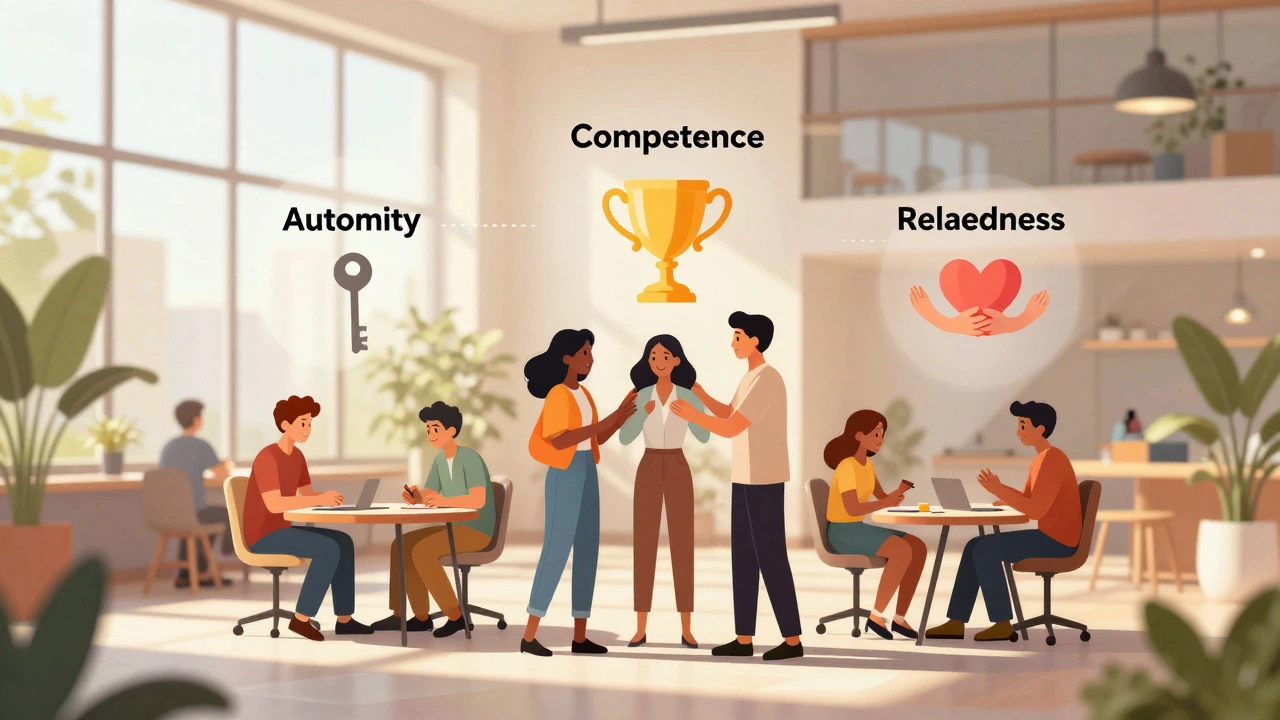
If money isn't the answer, what is? The most widely accepted framework in modern psychology is Self-Determination Theory (SDT), developed by Edward Deci and Richard Ryan. According to SDT, humans have three innate psychological needs that fuel our deepest motivation:
- Autonomy: The need to feel in control of our own lives and choices.
- Competence: The need to feel effective and good at what we do.
- Relatedness: The need to feel connected to and cared for by others.
When these three needs are met, we experience intrinsic motivation. This is when you do something because it feels naturally satisfying, not because you are being forced or paid to do it. Think about the last time you lost track of time while doing something you loved. That was autonomy, competence, and relatedness working together.
Autonomy is particularly critical. Studies show that even small increases in perceived choice can dramatically increase performance and well-being. When you feel like you are choosing your path, your brain releases dopamine associated with agency, making the effort feel less like work and more like play.
The Role of Purpose and Meaning
Beyond basic psychological needs, many experts argue that the highest form of motivation is purpose. Viktor Frankl, a psychiatrist and Holocaust survivor, famously wrote that those who had a "why" to live could bear almost any "how."
Purpose connects our daily actions to a larger narrative. It answers the question: "Does this matter?" When you believe your work contributes to something bigger than yourself-whether it's helping family, building a community, or advancing science-you tap into a reservoir of resilience that simple rewards cannot match.
This aligns with the concept of eudaimonia in Greek philosophy, which refers to human flourishing rather than mere pleasure. Eudaimonic motivation leads to long-term satisfaction, whereas hedonic motivation (seeking pleasure) often leads to emptiness once the high wears off.
Fear vs. Hope: Which Drives Us More?
A common debate in motivation circles is whether fear or hope is a stronger driver. Fear is certainly immediate. The threat of losing a job, facing embarrassment, or missing out (FOMO) triggers the amygdala, our brain's alarm system. This can produce short bursts of intense energy.
However, fear is exhausting. Chronic stress raises cortisol levels, which impairs cognitive function and decision-making over time. People driven primarily by fear often burn out or develop anxiety disorders. Hope, on the other hand, activates the prefrontal cortex, allowing for planning, creativity, and sustained effort.
Hope is not just wishful thinking; it is a strategic mindset. It involves identifying goals, finding pathways to achieve them, and maintaining the willpower to keep going despite obstacles. While fear might get you started, hope keeps you going.
How Motivational Quotes Fit In
So, where do motivational quotes fit into this complex picture? They are not the source of motivation itself, but they can act as cognitive triggers. A well-timed quote can shift your perspective, reminding you of your values or reigniting your sense of purpose.
For example, a quote about perseverance might help you reconnect with your sense of competence during a tough project. A quote about kindness might reinforce your need for relatedness. The key is to use quotes as mirrors, reflecting back what you already value, rather than as magic spells that create motivation from nothing.
To make quotes effective, you must personalize them. Ask yourself: "Why does this resonate with me right now?" If you can link the quote to one of your core needs (autonomy, competence, or relatedness), it becomes a tool for reinforcement rather than just decoration.
Practical Steps to Harness Your Motivation
Understanding the theory is one thing; applying it is another. Here is how you can align your daily life with the most powerful drivers of human behavior:
- Reframe Your Tasks for Autonomy: Instead of viewing tasks as obligations, ask yourself how you can approach them in a way that feels like a choice. Can you change the order? The method? The environment? Small choices restore a sense of control.
- Seek Mastery, Not Just Results: Focus on getting 1% better each day. Competence is built through incremental progress. Celebrate small wins to reinforce your sense of effectiveness.
- Connect With Others: Share your goals with supportive friends or mentors. Social accountability satisfies the need for relatedness and provides emotional support during setbacks.
- Define Your 'Why': Write down the deeper reason behind your goals. Is it freedom? Security? Contribution? Revisit this statement when motivation wanes.
- Use Quotes Strategically: Keep a list of quotes that speak to your specific challenges. Read them when you need a mental reset, not just for passive consumption.
Common Pitfalls to Avoid
Even with the best intentions, it is easy to sabotage your motivation. One common mistake is setting goals that are too vague. "Be successful" is not a goal; it is a wish. Specific, measurable objectives provide clear feedback loops that enhance competence.
Another pitfall is comparing yourself to others. Social comparison can undermine autonomy and competence, leading to feelings of inadequacy. Remember that everyone's journey is different. Focus on your own progress relative to your past self.
Finally, don't ignore the role of physical health. Sleep, nutrition, and exercise directly impact brain function. No amount of psychological trickery will overcome chronic fatigue or poor diet. Your body is the hardware that runs your motivational software.
| Type | Source | Sustainability | Impact on Well-being |
|---|---|---|---|
| Extrinsic | Money, Praise, Fear | Low (Hedonic Adaptation) | Mixed (Can cause stress) |
| Intrinsic | Interest, Enjoyment | High | Positive (Flow state) |
| Purpose-Driven | Meaning, Values | Very High | Very Positive (Resilience) |

The Neuroscience of Drive
At a biological level, motivation is governed by neurotransmitters like dopamine and serotonin. Dopamine is often misunderstood as the "pleasure molecule," but it is actually the molecule of "more." It drives anticipation and pursuit. When you set a goal and make progress, dopamine reinforces that behavior.
However, dopamine works best when there is uncertainty and challenge. If a task is too easy, you get bored. If it is too hard, you get anxious. The sweet spot is the "flow channel," where skill level matches challenge level. This state, described by psychologist Mihaly Csikszentmihalyi, is characterized by deep focus and loss of self-consciousness.
Designing your work to enter flow states regularly is one of the most effective ways to sustain motivation. Break large projects into manageable chunks that offer frequent feedback and slight challenges.
Cultural Perspectives on Motivation
It is also important to recognize that motivation is influenced by culture. Individualistic cultures (like the US) often emphasize personal achievement and autonomy. Collectivist cultures (like many in Asia and Africa) may place higher value on relatedness and duty to the group.
This doesn't mean one is better than the other. Both approaches satisfy core psychological needs, just through different lenses. Understanding your cultural context can help you tailor your motivational strategies. For instance, if you come from a collectivist background, framing your goals in terms of helping your family or community might be more powerful than focusing solely on personal glory.
Conclusion: Finding Your Unique Fuel
There is no single "most powerful" motivation that applies to everyone in every situation. However, the evidence strongly suggests that intrinsic drivers-autonomy, competence, and relatedness-combined with a sense of purpose, provide the most sustainable and fulfilling energy for human action.
External rewards and fear can kickstart behavior, but they rarely sustain it. By understanding your own psychological needs and aligning your goals with them, you can create a life that feels driven from within. Use motivational quotes as reminders of these truths, not as substitutes for them.
Is money the most powerful motivator?
Money is a strong extrinsic motivator, but its power diminishes over time due to hedonic adaptation. Once basic needs are met, intrinsic factors like autonomy and purpose become more significant drivers of long-term satisfaction and performance.
What is the difference between intrinsic and extrinsic motivation?
Intrinsic motivation comes from within, such as enjoying a task or feeling competent. Extrinsic motivation comes from outside, such as receiving money, praise, or avoiding punishment. Intrinsic motivation is generally more sustainable and linked to higher well-being.
How can I stay motivated when I don't feel like it?
Focus on small, manageable steps to build momentum. Remind yourself of your deeper purpose ('why'). Connect with supportive others for accountability. Sometimes, just starting the task for five minutes is enough to trigger the dopamine needed to continue.
Do motivational quotes actually work?
Quotes can work as cognitive triggers that remind you of your values or goals. However, they are not a substitute for action or structural changes in your life. Their effectiveness depends on how well they resonate with your personal beliefs and current challenges.
What is Self-Determination Theory?
Self-Determination Theory (SDT) is a psychological framework that identifies three basic psychological needs: autonomy, competence, and relatedness. Meeting these needs fosters intrinsic motivation and enhances overall well-being and performance.