What Is India's Slogan? Short, Powerful National Mottoes Explained
 Dec, 1 2025
People often ask, What is India's slogan? It’s a simple question, but the answer isn’t as straightforward as you might think. Unlike countries like the United States with "E Pluribus Unum" or France with "Liberté, Égalité, Fraternité," India doesn’t have one official slogan stamped on every government document or school textbook. But that doesn’t mean India lacks a voice. It has many. And some of them echo louder than others.
There’s No Single Slogan - But There Are Many
If you search online, you’ll find dozens of claims: "Unity in Diversity," "Satyameva Jayate," "Bharat Mata Ki Jai," even "Incredible India." But only one of these is legally recognized as the national motto. The rest are slogans, taglines, or cultural phrases that people use to express pride, identity, or aspiration.
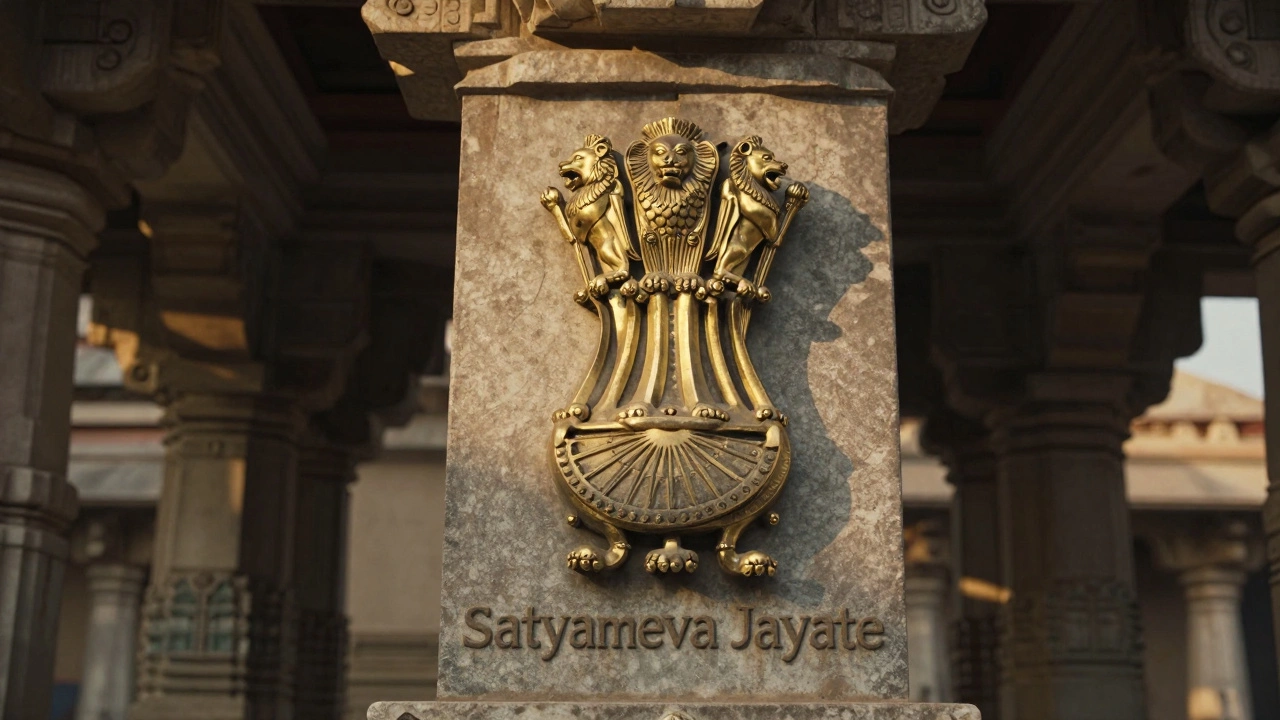
The only phrase officially adopted by the Government of India as its national motto is Satyameva Jayate - Sanskrit for "Truth Alone Triumphs." It’s engraved on the base of the national emblem, visible on all Indian currency, passports, and government letterheads. You’ve seen it. It’s the four lions standing back-to-back, with the wheel of law beneath them, and those three words carved in Devanagari script below.
This phrase comes from the Mundaka Upanishad, an ancient Hindu scripture dating back over 2,500 years. It wasn’t chosen because it sounds catchy. It was chosen because it carries weight - moral, philosophical, and historical. In a country with 22 official languages and thousands of dialects, a single Sanskrit phrase from a sacred text unites people across faiths and regions. That’s powerful.
Why People Confuse Other Phrases With the National Slogan
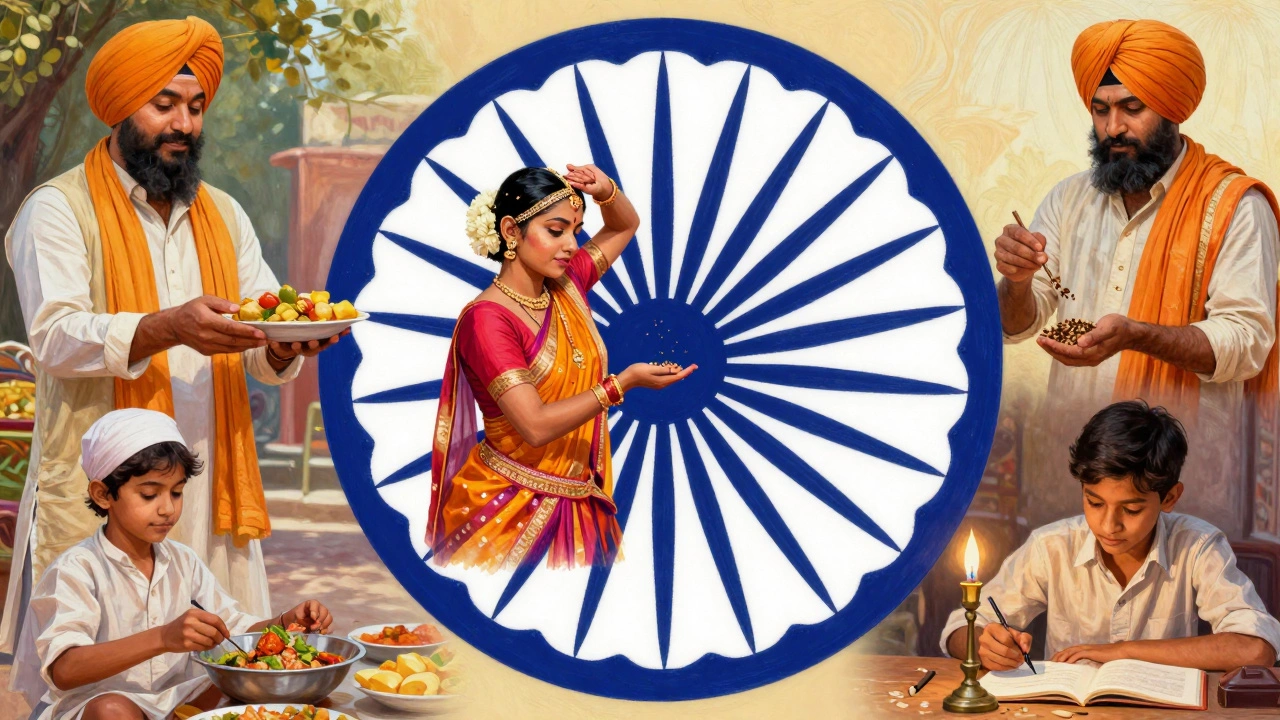
So why do so many think "Unity in Diversity" is India’s slogan? Because it’s true. And it’s repeated everywhere - in school textbooks, on tourism ads, in political speeches. It captures the spirit of India better than any single word could. From the snow-capped Himalayas to the tropical coasts of Kerala, from Punjabi bhangra to Tamil classical music, from Muslim mosques to Christian churches in Goa - India thrives because of its differences, not in spite of them.
"Unity in Diversity" isn’t official. But it’s real. And for many Indians, it’s more meaningful than any legal decree. It’s what you feel when you eat biryani in Kolkata, hear a Gurbani kirtan in Amritsar, and watch a classical Kathak dancer in Chennai - all in the same week.
Then there’s "Incredible India." That’s not a slogan at all - it’s a tourism campaign launched in 2002 by the Ministry of Tourism. It worked. Tourist arrivals jumped from 2.8 million in 2001 to over 10 million by 2019. But it’s marketing, not meaning. It doesn’t appear on the national emblem. It doesn’t grace the Parliament. It’s on billboards, posters, and Instagram ads.
Other Powerful Phrases That Feel Like Slogans
Even if they’re not official, some phrases carry the weight of a national anthem.
- Bharat Mata Ki Jai - "Victory to Mother India." Used in protests, rallies, and classrooms. It’s emotional. It’s patriotic. It’s not legal, but it’s deeply cultural.
- Jai Hind - "Hail India." Popularized by Subhas Chandra Bose during the freedom struggle. Still used by the Indian Army and in political speeches. It’s a battle cry turned salute.
- Vasudhaiva Kutumbakam - "The World Is One Family." From the Maha Upanishad. Often quoted by Indian diplomats at the UN. It reflects India’s ancient worldview - not isolation, but inclusion.
Each of these phrases answers a different question. "Satyameva Jayate" asks: What do we believe in? "Unity in Diversity" asks: Who are we? "Jai Hind" asks: How do we stand together?
What Does This Mean for You?
If you’re asking for India’s slogan because you need it for a poster, a school project, or a social media caption - here’s how to pick the right one:
- For formal, official use (government documents, certificates): Use Satyameva Jayate.
- For cultural expression (art, poetry, personal quotes): Use Unity in Diversity or Bharat Mata Ki Jai.
- For tourism or branding: "Incredible India" is fine - just know it’s not a national motto.
- For inspiration or motivation: Try Vasudhaiva Kutumbakam. It’s deeper than you think.
Don’t confuse marketing with meaning. Don’t mistake popularity for legality. India’s soul isn’t in one phrase - it’s in the space between them.
What’s Missing From the Conversation?
Most people don’t realize that India’s real slogan isn’t written anywhere. It’s lived.
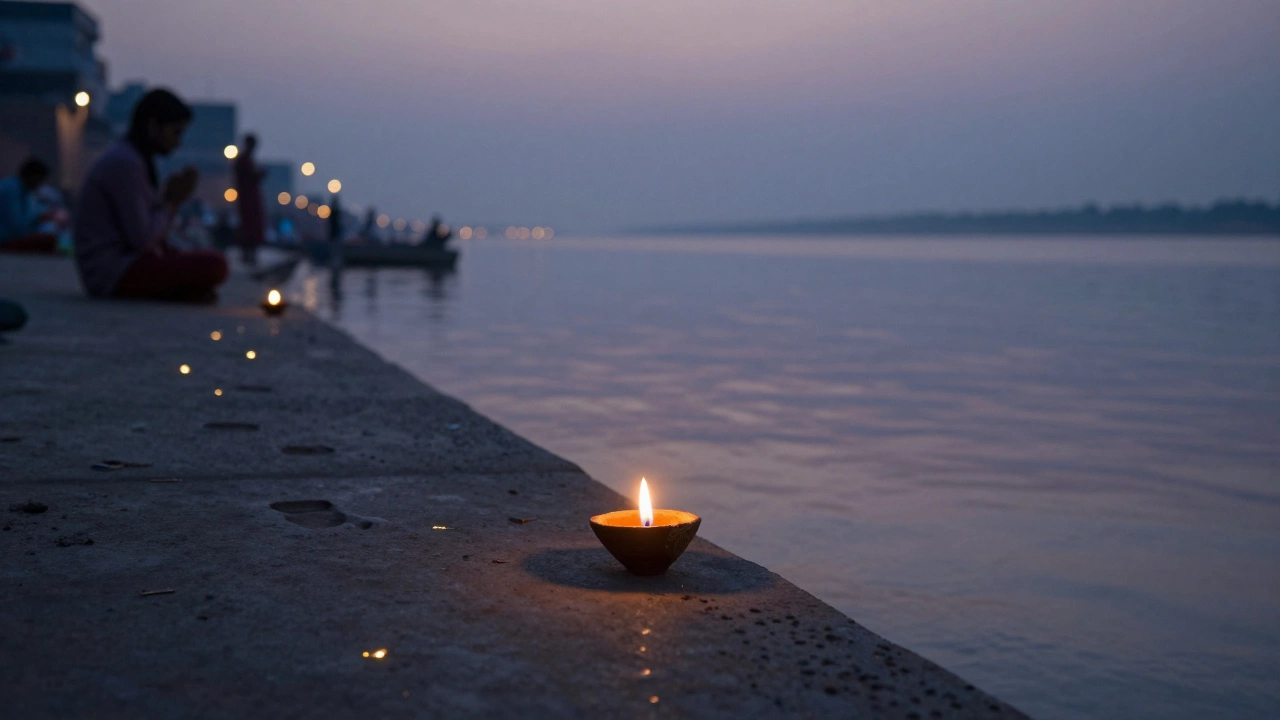
It’s the grandmother in Varanasi who lights a diya for a stranger’s child. It’s the rickshaw driver in Mumbai who gives a ride to a student who forgot his fare. It’s the farmer in Punjab who shares his seed with a neighbor who lost his crop. It’s the student in Delhi who studies till 3 a.m. because she wants to lift her family out of poverty.
India’s slogan isn’t carved in stone. It’s written in sweat, in silence, in stubborn hope. That’s why no single phrase can hold it all.
Final Thought: Why This Matters
When you ask, "What is India’s slogan?" - you’re not just asking for words. You’re asking for identity. You’re asking, "What does it mean to be Indian?"
The answer isn’t a slogan. It’s a thousand small acts of courage, kindness, and resilience. But if you need one line to carry that weight - go with Satyameva Jayate. Not because it’s official. But because truth, in the end, always wins.
Is "Unity in Diversity" India’s official slogan?
No, "Unity in Diversity" is not India’s official slogan. It’s a widely used cultural phrase that describes the country’s social fabric, but it has no legal status. The only official national motto is "Satyameva Jayate," which appears on the national emblem and official documents.
Where does "Satyameva Jayate" come from?
"Satyameva Jayate" comes from the Mundaka Upanishad, an ancient Sanskrit text that’s part of the Vedas, dating back over 2,500 years. It was adopted as India’s national motto in 1950 when the Constitution was framed. The phrase means "Truth Alone Triumphs" and reflects the philosophical foundation of India’s democratic values.
Can I use "Incredible India" as my slogan?
You can use "Incredible India" for personal or commercial use - it’s not trademarked for private use. But it’s not a national motto. It’s a tourism campaign created by the Indian government in 2002 to attract international visitors. If you’re making something official, like a school project or government document, use "Satyameva Jayate" instead.
Why is "Jai Hind" not the national slogan?
"Jai Hind" is a patriotic greeting popularized by Netaji Subhas Chandra Bose during the freedom movement. It’s used by the Indian Armed Forces and in political rallies, but it was never adopted as the national motto. The Constituent Assembly chose "Satyameva Jayate" because it represented a timeless principle, not a rallying cry.
Is there a difference between a slogan and a motto?
Yes. A motto is a formal, legally recognized phrase tied to a nation or institution - like "Satyameva Jayate." A slogan is a catchy phrase used for promotion, branding, or emotion - like "Unity in Diversity" or "Incredible India." One is official. The others are cultural or commercial.