What is India Best Known For? A Guide to Culture, Food, and Innovation
 Sep, 29 2026
India Heritage & Innovation Quiz
How well do you know the global influence of India? From ancient mathematics to modern fintech, test your understanding of one of the world's oldest civilizations.
Loading question...
Quiz Complete!
Ask someone on the street in London or New York what comes to mind when they hear "India," and you’ll likely get a rapid-fire list: spicy curry, the Taj Mahal, cricket, and maybe some spiritual mysticism. But that’s just the postcard version. India is a civilization that has been running continuously for over 5,000 years, and its influence stretches far beyond tourist brochures. It’s about how we compute our taxes, how millions practice mindfulness, and why your smartphone might have software written by engineers from Bangalore.
If you’re trying to understand the real weight of this country-whether you’re planning a trip, doing business here, or just curious about where half the world’s population lives-you need to look past the stereotypes. Let’s break down what makes India globally significant, not just as a place, but as a force that shapes modern life.
The Global Kitchen: More Than Just Curry
Food is probably the most immediate way people connect with India. But saying "Indian food" is like saying "European food"-it’s too broad to be accurate. The cuisine varies wildly from state to state. In Punjab, up north, you’ll find rich, creamy dishes like Butter Chicken and Dal Makhani, cooked in tandoor ovens. Down south in Kerala or Tamil Nadu, the focus shifts to coconut, rice, fermented lentils (dosas), and fiery red chilies.
What really changed global palates wasn’t just the taste, but the technique. Ayurveda, an ancient system of medicine rooted in traditional Indian medicine, introduced the world to the idea that spices aren’t just for flavor-they’re functional. Turmeric isn’t just yellow powder; it’s anti-inflammatory. Ginger helps digestion. Cumin aids metabolism. This holistic approach to eating has fueled the massive global demand for turmeric lattes and ginger teas. You can’t walk into a health store in Berlin without seeing these ingredients front and center, thanks to Indian culinary wisdom.
Wellness and Spirituality: The Export of Peace
Long before wellness became a billion-dollar industry, India was practicing it. Yoga is one of India’s most significant cultural exports. Originating in northern India around 5,000 years ago, it started as a spiritual discipline to quiet the mind, not just a gym class for flexibility. Today, the International Day of Yoga is celebrated worldwide, proving that this practice has universal appeal.
Beyond yoga, concepts like meditation and mindfulness have deep roots in Indian philosophy, particularly through Buddhism and Hinduism. While Silicon Valley talks about "mindfulness apps," the source code for these ideas comes from ancient texts like the Upanishads. If you’ve ever tried to sit still and breathe deeply to reduce stress, you’re tapping into an Indian tradition. It’s not just religion; it’s practical mental hygiene that the world has adopted because it works.
The Digital Engine: IT Services and Startups
Here’s a fact that surprises many: India is often called the "back office of the world," but that title undersells its role. Cities like Bangalore (officially Bengaluru) are tech hubs comparable to Silicon Valley. Companies like Infosys and TCS employ hundreds of thousands of engineers who keep the digital infrastructure of global banks, airlines, and retailers running smoothly.
But it’s not just about outsourcing anymore. India has become a startup powerhouse. Think about how you pay for things. The Unified Payments Interface (UPI) is a real-time payment system developed by the National Payments Corporation of India. It allows you to transfer money instantly using just a phone number. It’s so efficient and user-friendly that countries like Singapore and France are looking at adopting similar models. When you use a digital wallet in India, you’re using technology that is setting global standards for financial inclusion.

Cinema and Soft Power: The Bollywood Effect
Hollywood gets the headlines, but India produces more films annually than any other country. Bollywood, based in Mumbai, is the Hindi-language film industry that dominates South Asia, the Middle East, and parts of Africa and Europe. Unlike Hollywood’s trend toward realism, Bollywood embraces melodrama, music, and dance. These elements create an emotional connection that transcends language barriers.
You don’t need to speak Hindi to enjoy a Shah Rukh Khan movie. The storytelling formula-love, family conflict, triumph, and a song sequence-is universally understood. This cultural reach gives India significant "soft power." When a young person in Nigeria wears jeans and listens to Punjabi pop, that’s Indian culture influencing global lifestyle trends. It’s a subtle but powerful form of influence that doesn’t require military strength or economic threats.
Ancient Innovations We Still Use
We often think of innovation as something new, but India gave the world foundational tools centuries ago. Here are three things you probably use daily that have Indian origins:
- The Number Zero: Without the concept of zero, which was formalized by Indian mathematicians like Aryabhata, modern computing, calculus, and binary code wouldn’t exist. It sounds basic now, but treating "nothing" as a number was a revolutionary leap.
- Chess: Originally known as Chaturanga, this strategy game originated in India during the Gupta Empire. It evolved into the chess we know today after traveling to Persia and then Europe.
- Sugar Refining: Indians were the first to develop techniques for crystallizing sugar cane juice into granules, making sugar transportable and affordable for the masses.
These aren’t just historical footnotes; they are the building blocks of modern science and entertainment. Every time you do math or play a board game, you’re engaging with Indian intellectual heritage.
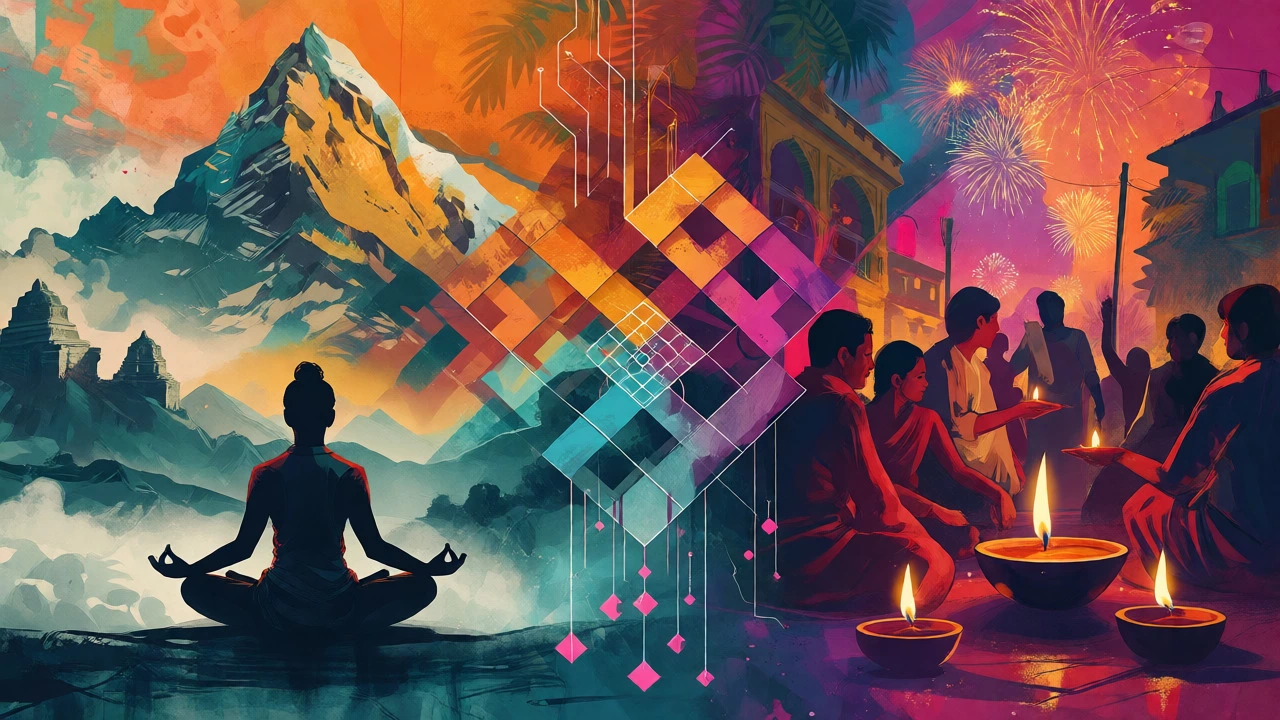
Diversity: The World’s Largest Democracy
Perhaps the most defining characteristic of India is its sheer complexity. With over 1.4 billion people, India is home to 22 official languages and hundreds of dialects. Imagine if every state in the US had a different primary language, currency preference, and religious majority-that’s roughly what India manages to hold together.
This diversity extends to festivals. Diwali, Eid, Christmas, Gurpurab, Pongal, and Onam are all celebrated with equal fervor across the country. It’s a living example of secular coexistence. For a traveler or observer, this means no two days are the same. One day you’re watching camel rides in Rajasthan, the next you’re surfing in Goa, and the following week you’re trekking in the Himalayas. The geographical and cultural variety is unmatched, offering a microcosm of the entire human experience within one border.
| Area | Specific Contribution | Global Impact |
|---|---|---|
| Mathematics | Concept of Zero & Decimal System | Foundation of modern computing and science |
| Health | Yoga & Ayurveda | Global wellness industry standard |
| Technology | UPI & IT Services | Financial inclusion & global software backbone |
| Culture | Bollywood & Music | Influence on fashion, dance, and media |
Frequently Asked Questions
Is India only known for poverty and slums?
No, while poverty exists, India is also home to some of the world's richest cities and fastest-growing economies. It has a massive middle class, advanced space programs (like ISRO's Mars mission), and a thriving startup ecosystem. Media often highlights challenges, but overlooks the rapid development and wealth creation happening simultaneously.
Why is yoga considered an Indian export?
Yoga originated in ancient India as a spiritual and physical discipline described in texts like the Yoga Sutras of Patanjali. While practiced globally now, its philosophical roots, techniques, and terminology remain distinctly Indian, making it a key part of India's cultural heritage and soft power.
What is the significance of the UPI system?
The Unified Payments Interface (UPI) revolutionized digital payments in India by allowing instant bank-to-bank transfers via mobile devices. Its success has influenced global fintech trends, demonstrating how developing nations can leapfrog traditional banking infrastructure to adopt cutting-edge digital finance solutions.
How does Indian cinema differ from Hollywood?
Indian cinema, particularly Bollywood, typically integrates music, dance, and melodrama directly into the narrative structure, whereas Hollywood usually keeps these elements separate. Indian films are often longer and emphasize family values and emotional resolution, appealing to audiences who value communal and expressive storytelling.
Did India really invent chess?
Yes, historians trace the origins of chess to the Gupta Empire in India, where it was known as Chaturanga. It spread to Persia, becoming Shatranj, and later evolved into the modern game in Europe. The strategic depth and piece movements have their roots in this ancient Indian war simulation game.