What is a Famous Indian Motivational Quote? Top Examples & Context
 Aug, 25 2026
Find Your Motivational Anchor
Select a scenario on the left to reveal your personalized quote.
When people ask for a famous Indian motivational quote, they usually want more than just words on a screen. They are looking for a spark. A reminder that struggle is part of the journey and that wisdom has been passed down through generations in this country. India is one of the oldest civilizations on Earth, and its literary and spiritual traditions are packed with insights on resilience, duty, and inner strength.
You might have seen these lines on social media posts or heard them from elders during tough times. But do you know where they come from? Understanding the source makes the message hit harder. Whether it’s from ancient scriptures, modern literature, or the lives of great leaders, these quotes carry a weight that generic internet advice often lacks.
The Power of Ancient Wisdom
India’s most enduring motivational messages often come from texts written thousands of years ago. The Bhagavad Gita is a 700-verse Hindu scripture that forms part of the epic Mahabharata, focusing on duty, action, and detachment. It is not just a religious text; it is a manual for living under pressure. One of the most cited lines comes from Chapter 2, Verse 47:
"Karmanye vadhikaraste ma phaleshu kadachana."
In simple terms, this means: "You have a right to perform your prescribed duties, but you are not entitled to the fruits of your actions." This concept, known as Nishkama Karma, teaches us to focus entirely on the process rather than obsessing over the result. In today’s high-stress world, this is pure gold. It tells you to stop worrying about whether you will get the promotion or win the game, and instead give your best effort in the moment. When you detach from the outcome, anxiety drops, and performance often improves.
Modern Voices: Literature and Leadership
While ancient texts provide the foundation, modern Indian thinkers have translated these ideas into contemporary language. Rabindranath Tagore was an Indian polymath who won the Nobel Prize in Literature in 1913, known for his poetry, songs, and philosophical writings. His works often bridge the gap between personal emotion and universal truth. One powerful line attributed to him is: "Where the mind is without fear and the head is held high..." This speaks to the freedom that comes from overcoming internal doubts. If you feel stuck by self-doubt, this quote reminds you that clarity of thought is the first step toward any achievement.
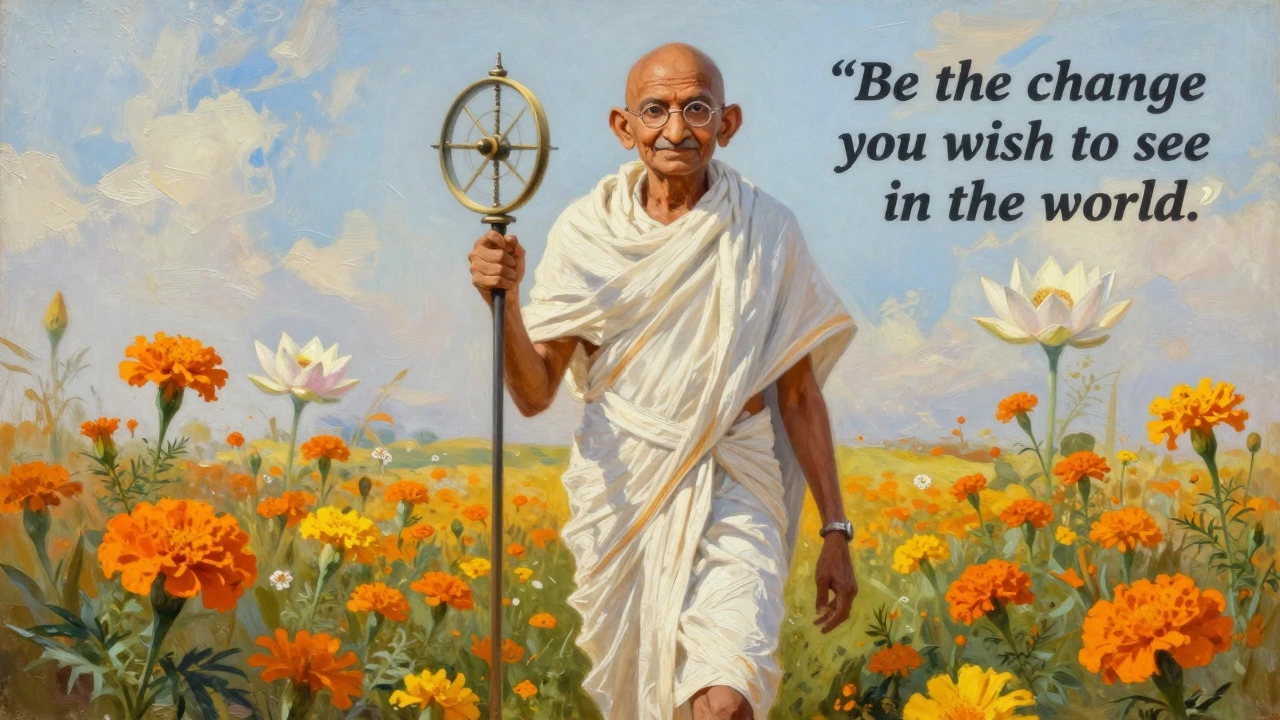
Then there is Mahatma Gandhi, the leader of the nonviolent Indian independence movement, widely regarded as the father of the nation. His philosophy was built on simplicity and moral courage. He famously said, "Be the change you wish to see in the world." At first glance, it sounds like a cliché. But when you think about it, it shifts the burden of responsibility. Instead of waiting for society to fix itself, you start fixing yourself. It’s a practical approach to motivation. You don’t need permission to improve your habits, your speech, or your work ethic. You just need to start.
Regional Gems: Beyond Hindi and Sanskrit
Many people assume Indian quotes are only from Hindi or Sanskrit sources. That’s a big mistake. India is a linguistic mosaic, and each region has its own flavor of wisdom. For example, in Tamil culture, the poet Kaali (or Kalidas, depending on the specific verse translation context, though Kaali is a distinct figure in some regional folklore) offers sharp insights on human nature. However, a more universally recognized modern voice is Sarojini Naidu, an Indian poet and political activist, known as the Nightingale of India. Her poetry often celebrated women’s empowerment and national pride. Her words encourage readers to find their voice and stand tall, which resonates deeply with anyone feeling unheard in professional or personal spaces.
Even in everyday proverbs, there is motivational fuel. The phrase "Jai Jawani Jai Kisan" (Hail Youth, Hail Farmer) became a rallying cry in the 1960s. It wasn’t just a slogan; it was a statement of value. It told young people that their energy matters and that hard work is respected. These cultural anchors remind us that motivation isn’t always about grand gestures. Sometimes, it’s about recognizing your own worth within the community.
Why Do These Quotes Resonate?
You might wonder why an old verse from a 2,000-year-old epic still motivates a software engineer in Bangalore or a student in Delhi. The answer lies in universality. Human struggles-fear of failure, desire for recognition, need for purpose-don’t change with technology. What changes is the context. An Indian motivational quote works because it connects you to a lineage of thinkers who faced similar dilemmas. It creates a sense of continuity. You are not alone in your struggle. People before you walked the same path, and they left breadcrumbs of wisdom for you to follow.
Also, many of these quotes emphasize action over thought. Western self-help often focuses on mindset shifts, visualization, and positive thinking. Indian philosophy, particularly the Gita and Yoga traditions, emphasizes disciplined action. It’s less about "manifesting" and more about "doing." This makes the quotes feel grounded and practical. They don’t promise magic; they promise results through consistent effort.
How to Use These Quotes in Daily Life
Reading a quote is nice, but applying it is better. Here is how you can integrate these insights into your routine:
- Pick one mantra: Don’t try to memorize ten quotes at once. Choose one that speaks to your current challenge. If you’re stressed about outcomes, use the Gita’s lesson on action.
- Write it down: Keep it on a sticky note on your monitor or in your phone wallpaper. Visual reminders keep the intention alive.
- Reflect in the morning: Spend two minutes reading the quote and asking yourself how it applies to the day ahead. This sets a tone of intentionality.
- Share it wisely: Send it to a friend who is going through a tough time. Sometimes, hearing it from someone else makes it click.
For instance, if you are preparing for a major exam or job interview, the Gita’s advice on detaching from results can help you stay calm. You study hard (action), but you don’t let the fear of failing ruin your sleep (detachment). This balance leads to better performance than pure anxiety-driven cramming.
Common Misconceptions About Indian Quotes
One common issue is misattribution. On social media, you’ll often see quotes assigned to the wrong person. For example, lines are frequently credited to Osho (Rajneesh) or A.P.J. Abdul Kalam (former President of India and aerospace scientist) even when they come from different sources. While the sentiment might be good, knowing the true origin adds depth. A.P.J. Abdul Kalam is a renowned aerospace scientist who served as the 11th President of India, known for his inspiring speeches to youth. His quotes often focus on education, innovation, and dreaming big. His book Wings of Fire is a staple for students across India. If you attribute a quote to him, make sure it aligns with his documented views on science and progress.
Another misconception is that these quotes are only for spiritual people. That’s far from the truth. Business leaders, athletes, and artists all draw from these sources. The principles of discipline, focus, and resilience are universal tools, regardless of your field.
Choosing the Right Quote for Your Situation
Different situations call for different types of motivation. Here is a quick guide to help you pick the right one:
| Scenario | Recommended Quote Source | Core Message |
|---|---|---|
| Feeling overwhelmed by results | Bhagavad Gita | Focus on action, not outcomes |
| Lacking confidence | Rabindranath Tagore | Find inner freedom and courage |
| Wanting to create change | Mahatma Gandhi | Start with yourself |
| Struggling with ambition | A.P.J. Abdul Kalam | Dream big and educate yourself |
| Feeling unheard | Sarojini Naidu | Find your voice and stand proud |
This table helps you quickly identify which type of wisdom fits your current mood. If you’re in a high-pressure work environment, the Gita’s pragmatic advice is likely more useful than poetic inspiration. If you’re dealing with creative blocks, Tagore’s emphasis on mental freedom might unlock new ideas.
Frequently Asked Questions
What is the single most famous Indian motivational quote?
The most widely recognized quote is from the Bhagavad Gita: "Karmanye vadhikaraste ma phaleshu kadachana" (You have a right to perform your prescribed duties, but you are not entitled to the fruits of your actions). It is central to Indian philosophy regarding action and success.
Are Indian motivational quotes only religious?
No. While many originate from religious texts like the Gita or Upanishads, others come from secular sources like literature (Tagore), politics (Gandhi, Kalam), and regional proverbs. The core themes of resilience, duty, and wisdom are universal and applicable to anyone, regardless of faith.
Who is A.P.J. Abdul Kalam and why are his quotes popular?
A.P.J. Abdul Kalam was a former President of India and a distinguished aerospace scientist. His quotes are popular because he connected deeply with the youth, emphasizing education, hard work, and dreaming big. His book 'Wings of Fire' is a bestseller in India for its honest look at perseverance.
How can I remember these quotes effectively?
Associate each quote with a specific situation or emotion. For example, link the Gita's verse on action to moments when you feel anxious about a deadline. Repetition through daily reflection or writing them down also helps retention. Using them as phone wallpapers ensures constant visual exposure.
Do these quotes apply to modern business and tech careers?
Absolutely. Concepts like 'Nishkama Karma' (acting without attachment to results) are highly relevant in high-stakes environments like tech startups or finance. They help reduce burnout by shifting focus from constant outcome-chasing to sustainable process-oriented work. Many CEOs and engineers cite these principles for maintaining mental clarity.