What is a Catchy Motto? A Guide to Creating Memorable Personal Mantras
 Sep, 15 2026
Motto Forge
Craft a motto that sticks. Input your core values and actions below to generate options, or test your own creation for "catchiness".
Generate Ideas
Analyze Your Motto
- Brevity (< 10 words) --
- Rhythm & Structure --
- Emotional Impact --
Feedback will appear here.
Your New Mantra
You’ve probably seen them everywhere. On t-shirts in Delhi’s Hauz Khas Village, pinned to Instagram bios, or stitched into the lining of a high-end bag. They are short, punchy, and stick in your brain like a bad pop song hook. But what is a catchy motto, really? Is it just a fancy word for "slogan," or does it serve a deeper purpose in how we present ourselves to the world?
A motto isn’t just words strung together. It’s a compressed version of your values, your drive, or your brand’s promise. Think of Nike’s "Just Do It." That’s not just a phrase; it’s a command that removes hesitation. When you understand the mechanics behind these tiny powerhouses, you can craft one that actually works for you, rather than copying the latest viral trend.
The Anatomy of a Catchy Motto
To build a good one, you first need to know what makes a motto tick. It’s not about using big words. In fact, simplicity is king. The most memorable mottos share specific traits that make them easy to recall and hard to ignore.
Catchy Motto is a brief statement or maxim adopted by an individual or organization as a guiding principle or expression of intent. Unlike a general quote, which might be passive reflection, a motto is active. It directs behavior.
Here are the three non-negotiable elements:
- Brevity: If it takes more than five seconds to say, it’s too long. Aim for under ten words. The human brain has limited working memory; if they have to hold onto too many concepts, they’ll drop the whole thought.
- Rhythm: Notice how "Stay Hungry, Stay Foolish" has a beat? Alliteration, rhyme, or parallel structure helps the brain latch onto the phrase. It turns language into music.
- Emotional Resonance: It needs to hit a nerve. Whether it’s ambition, resilience, or kindness, the motto must align with a feeling you want to evoke in yourself or others.
Consider the difference between "I try to work hard every day" and "Grind Now, Shine Later." The first is a description. The second is a motto. One informs; the other motivates.
Motto vs. Slogan vs. Quote: Clearing the Confusion
People often mix these up, but they serve different jobs. Knowing the distinction helps you pick the right tool for the job.
| Feature | Motto | Slogan | Quote |
|---|---|---|---|
| Purpose | Guides personal behavior or internal culture. | Attracts customers and defines market position. | Inspires, reflects wisdom, or shares perspective. |
| Audience | Self or team members. | Consumers or public. | General audience or social media followers. |
| Lifespan | Long-term, often lifelong. | Medium-term, changes with marketing campaigns. | Variable, often tied to current trends. |
| Tone | Intimate, directive, philosophical. | Persuasive, energetic, commercial. | Reflective, witty, or authoritative. |
For example, Apple’s "Think Different" started as a campaign slogan but became a cultural motto for creatives worldwide. However, if you put "Buy iPhone 15 Pro Max Today!" on your wall, it wouldn’t inspire you at 6 AM. That’s a transactional slogan, not a motto.
Why You Need a Personal Motto
You might think, "Do I really need this? Can’t I just live my life?" Sure, you can. But having a clear verbal anchor speeds up decision-making. When you’re faced with a tough choice-take the risky job or stay safe?-your motto acts as a filter.
If your motto is "Comfort is the Enemy of Growth," you know immediately that the safe option is likely the wrong one for you. It reduces cognitive load. Instead of weighing pros and cons for hours, you apply your rule and move forward.
Moreover, in our hyper-connected world, your digital footprint matters. Your LinkedIn headline, your Twitter bio, or even your email signature are prime real estate. A well-crafted motto signals clarity of purpose. It tells people who you are before you even speak. For freelancers and entrepreneurs in India’s competitive gig economy, this clarity can be the difference between getting hired or being overlooked.
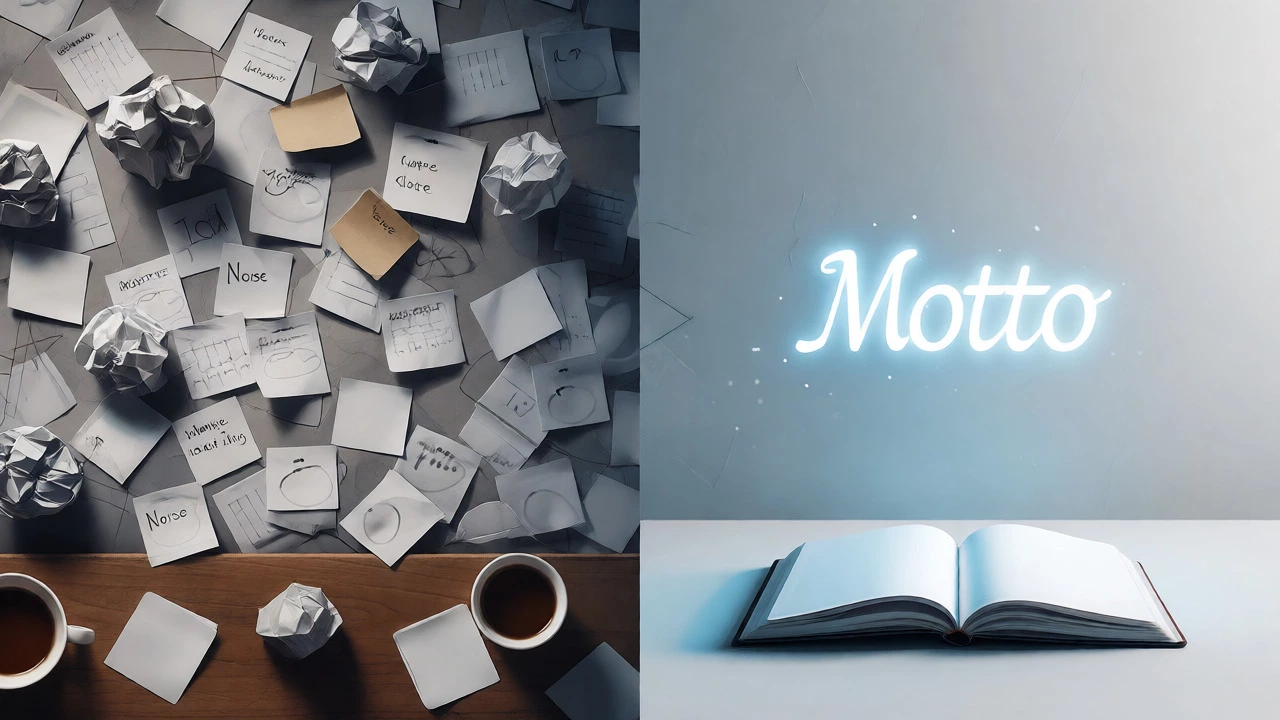
How to Craft Your Own (Step-by-Step)
Don’t just copy Steve Jobs. Find your own voice. Here is a practical process to generate a motto that feels authentic to you.
- Identify Your Core Value: What do you care about most? Is it integrity? Speed? Creativity? Kindness? Write down your top three values. Don’t overthink it. Go with your gut.
- List Associated Actions: How do those values show up in daily life? If your value is "Creativity," actions might include "experimenting," "breaking rules," or "connecting dots."
- Combine and Compress: Try mixing values and actions. "Create Without Fear." "Connect the Dots." "Act with Integrity."
- Test the Rhythm: Say it out loud. Does it stumble? If so, cut a word. Change "Always Be Honest" to "Truth First." It’s sharper.
- The 'T-Shirt Test': Would you wear this on a shirt? If it feels cringe-worthy, tweak it. It should feel empowering, not embarrassing.
Let’s look at a real-world scenario. Imagine a graphic designer named Priya from Bangalore. She struggles with perfectionism, often missing deadlines because she tweaks pixels endlessly. Her core value is "Progress," and her pain point is "Stagnation." She tries "Make Good Things Fast." Too clunky. She tries "Done is Better Than Perfect." Classic, but maybe too common. Finally, she lands on "Ship It." Short, aggressive, and perfectly aligned with her need to overcome inertia. It becomes her mantra every time she hesitates to hit 'send'.
Common Pitfalls to Avoid
Even well-intentioned mottos can fail. Here’s where people go wrong.
Vagueness: "Be Awesome" means nothing. It’s filler. Specificity creates impact. "Solve Hard Problems" is actionable.
Negativity: While some mottos use negative framing effectively (e.g., "Never Settle"), constant negativity drains energy. "Don’t Fail" is less inspiring than "Aim High." Frame your motto around what you *want*, not just what you want to avoid.
Inauthenticity: This is the biggest killer. If you choose "Hustle Harder" but you value family above all else, you’ll feel guilty every time you repeat it. Your motto must reflect your actual truth, not an aspirational fantasy. If you’re naturally calm, "Chaos is Opportunity" might fit better than "Dominate the Market."

Examples Across Different Contexts
Context changes everything. A motto for a startup founder differs vastly from one for a yoga instructor.
For Entrepreneurs: Focus on resilience and vision. "Build It, Break It, Fix It." This embraces failure as part of the process.
For Students: Focus on discipline and curiosity. "Learn Something New Every Day." It sets a manageable, consistent standard.
For Artists: Focus on expression and courage. "Art is Risk." It reminds them that safety kills creativity.
For Leaders: Focus on service and accountability. "Lead by Serving." It shifts the focus from ego to support.
Notice how each example addresses a specific psychological barrier or goal relevant to that group. They aren’t generic platitudes; they are targeted tools.
Keeping Your Motto Fresh
Your motto shouldn’t be carved in stone forever. People change. Values evolve. A motto that served you in your twenties might feel childish in your forties. Review it annually. Ask yourself: "Does this still resonate? Or am I clinging to an old identity?"
It’s okay to let go. If "No Excuses" no longer fits your balanced lifestyle, swap it for "Balance Over Burnout." There is no shame in updating your operating system. In fact, adapting your motto shows self-awareness-a trait far more impressive than rigid consistency.
Is a motto the same as a hashtag?
No. A hashtag is a discovery tool used for categorization on social platforms. A motto is a philosophical guide. While you can turn a motto into a hashtag, their functions differ. A hashtag helps people find content; a motto helps you define your stance.
Can I have more than one motto?
Yes, but keep it minimal. Having three distinct mottos for different areas of life (e.g., one for career, one for health, one for relationships) is manageable. Having ten dilutes their power. Each should address a specific domain without conflicting with the others.
Should my motto be in English or my native language?
Use whichever language hits harder emotionally. For many Indians, Hindi or regional languages carry deeper emotional weight and cultural nuance. "Karm Karo" (Do Work) might resonate more viscerally than "Work Hard." Choose the language that triggers the strongest internal response.
How long should a motto be?
Ideally, between two and seven words. Anything shorter might lack context; anything longer becomes a sentence rather than a motto. Brevity ensures memorability and ease of repetition during stressful moments.
Where should I display my motto?
Place it where you will see it daily but not so prominently that it loses impact. Common spots include your phone lock screen, a sticky note on your monitor, or the first line of your journal. The goal is subconscious reinforcement, not constant conscious attention.